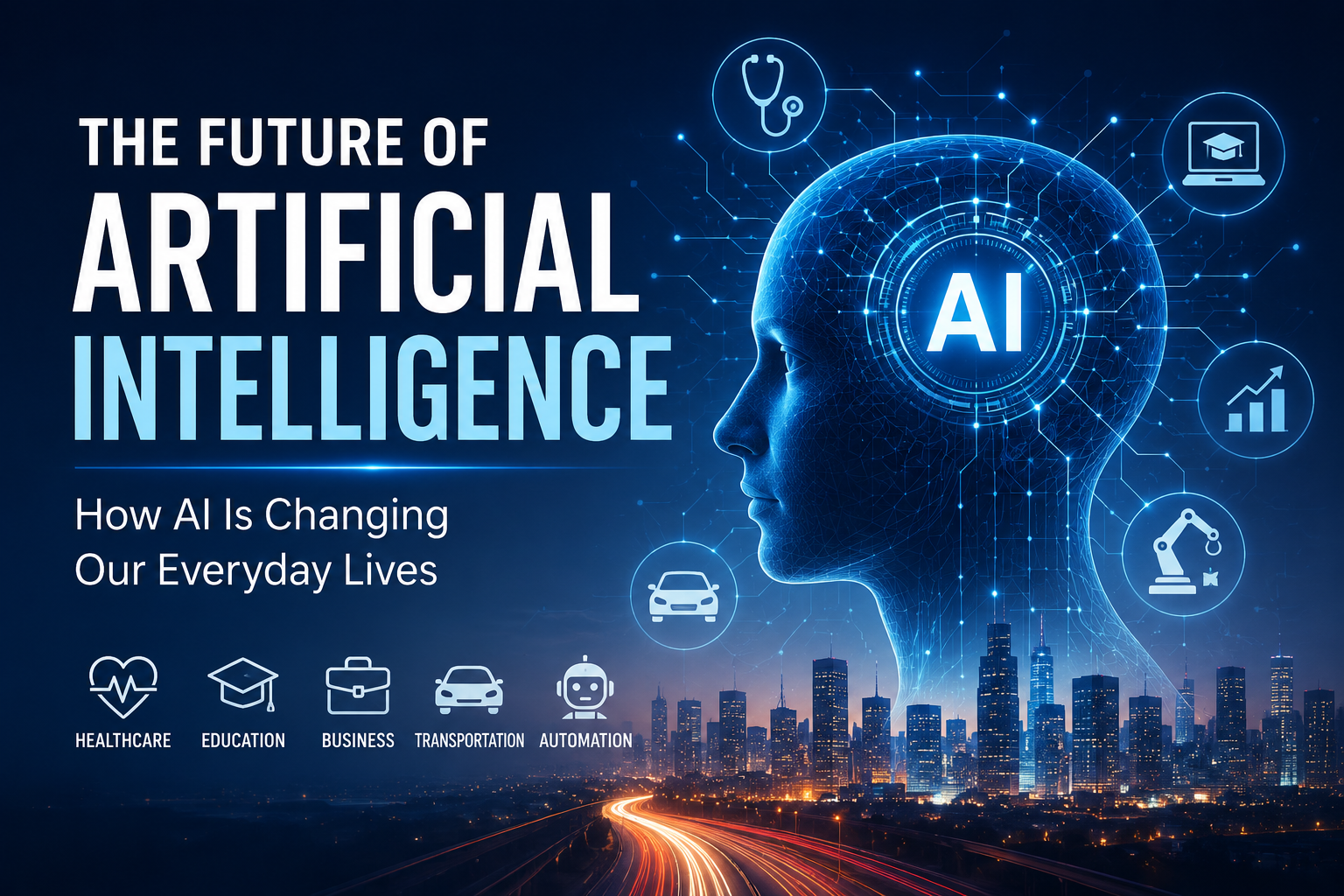
Introduction
Artificial Intelligence (AI) has rapidly evolved from a futuristic concept into an essential part of modern life. From voice assistants and recommendation systems to medical diagnosis and self-driving technologies, AI is transforming how people work, communicate, learn, and solve problems.
As technology continues to advance, understanding artificial intelligence has become increasingly important for businesses, students, professionals, and everyday users alike.
In this article, we’ll explore what AI is, how it affects our daily lives, its benefits, potential challenges, and what the future may hold.
What Is Artificial Intelligence?
Artificial Intelligence refers to computer systems designed to perform tasks that normally require human intelligence. These tasks include:
- Learning from data
- Recognizing speech and images
- Solving complex problems
- Making predictions
- Understanding natural language
- Automating repetitive work
Rather than following only fixed instructions, modern AI systems improve their performance by analyzing large amounts of information.
How AI Is Used in Everyday Life
Many people interact with AI every day without realizing it.
Smart Assistants
Virtual assistants help users:
- Set reminders
- Answer questions
- Control smart home devices
- Schedule appointments
Online Shopping
E-commerce platforms use AI to recommend products based on browsing history and customer preferences, creating a more personalized shopping experience.
Healthcare
Healthcare organizations use AI to:
- Detect diseases earlier
- Analyze medical images
- Support doctors with diagnoses
- Improve patient care
- Accelerate medical research
Education
Educational platforms use AI to personalize learning by adapting lessons according to a student’s progress and learning style.
Students receive customized recommendations, quizzes, and study plans that improve learning outcomes.
Finance
Banks and financial institutions rely on AI for:
- Fraud detection
- Credit scoring
- Risk assessment
- Investment analysis
- Customer support
Transportation
Modern transportation increasingly depends on AI through:
- Navigation systems
- Traffic prediction
- Route optimization
- Driver assistance technologies
- Autonomous vehicle research
Benefits of Artificial Intelligence
AI offers significant advantages across many industries.
Increased Efficiency
Automation reduces repetitive work, allowing people to focus on more valuable tasks.
Better Decision-Making
AI analyzes large datasets quickly, helping businesses make informed decisions.
Improved Customer Experience
AI-powered chatbots provide instant customer support around the clock.
Enhanced Accuracy
Machine learning systems reduce human error in many specialized applications, including manufacturing and healthcare.
Innovation
AI enables new products, services, and business models that were previously impossible.
Challenges of Artificial Intelligence
While AI provides numerous opportunities, it also introduces important challenges.
Privacy Concerns
AI systems often require large amounts of data, making privacy protection essential.
Job Transformation
Automation changes workforce demands, requiring employees to develop new digital skills.
Bias in Algorithms
Poor-quality training data can result in unfair or inaccurate AI decisions.
Ethical Considerations
Responsible AI development requires transparency, accountability, and human oversight.
The Future of AI
Artificial intelligence is expected to become even more integrated into daily life.
Future developments may include:
- Smarter healthcare systems
- Personalized education
- More efficient public services
- Sustainable energy management
- Advanced robotics
- Intelligent business automation
Rather than replacing humans entirely, AI will increasingly serve as a powerful tool that enhances productivity and supports better decision-making.
Tips for Individuals and Businesses
To prepare for an AI-driven future:
- Learn digital and AI-related skills.
- Stay informed about emerging technologies.
- Use AI responsibly and ethically.
- Protect personal and organizational data.
- Combine human creativity with AI-powered tools.
Organizations that adopt AI thoughtfully will likely gain significant competitive advantages over time.
Frequently Asked Questions (FAQ)
What is Artificial Intelligence in simple words?
Artificial Intelligence is technology that enables computers to perform tasks that typically require human thinking, learning, and decision-making.
Is AI replacing human jobs?
AI is automating certain repetitive tasks, but it is also creating new career opportunities in technology, data science, healthcare, education, and many other industries.
What industries use AI?
AI is widely used in healthcare, finance, education, manufacturing, retail, transportation, agriculture, cybersecurity, and entertainment.
Can small businesses benefit from AI?
Yes. Many affordable AI tools help small businesses automate customer service, marketing, content creation, data analysis, and workflow management.
Is AI safe?
AI can be highly beneficial when developed and used responsibly. Privacy, security, transparency, and ethical standards are essential for safe AI adoption.
Final Thoughts
Artificial Intelligence is no longer a technology of the future—it is already shaping the world around us. From improving healthcare and education to transforming businesses and simplifying everyday tasks, AI continues to unlock new possibilities across every industry.
As innovation accelerates, individuals and organizations that embrace continuous learning and responsible AI adoption will be better positioned for long-term success. Understanding how AI works today is the first step toward preparing for tomorrow’s digital economy.
